
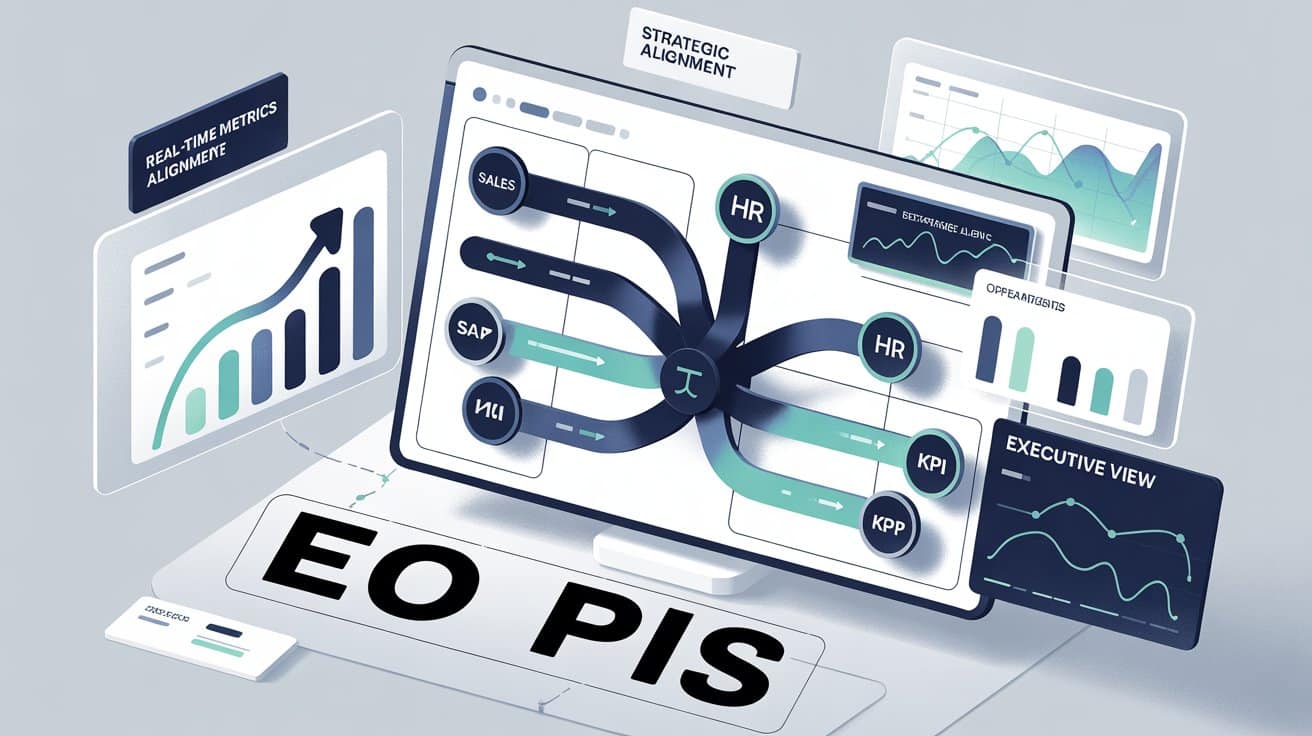
Leaders today face overwhelming data from separate systems—finance reports, sales spreadsheets, and marketing analytics. Despite mountains of information, insight remains elusive. Teams work toward different goals, creating strategic drift. Traditional KPIs track isolated tasks but miss organizational alignment. EO Pis emerged as the solution, offering executives a consolidated view of key operational metrics in real-time. Standing for Executive Operations Performance Indicator System, EO Pis bridges daily work with long-term strategy.
This framework transforms how organizations monitor performance, make decisions, and allocate resources. By filtering noise and focusing on outcome-centric indicators, businesses achieve clarity previously impossible with siloed departmental dashboards.
Understanding EO Pis: Beyond Traditional Performance Metrics
Most executives misunderstand what makes EO Pis different. It’s not another dashboard—it’s a governed measurement layer.
In finance, practitioners call it the End-of-Period Indicator System. Pre-close signals surface unreconciled balances, late journals, and forecast-to-actual gaps before the official close. Controllers resolve issues mid-period instead of scrambling at month-end.
Executive management interprets it as outcome-aligned measures helping leaders manage by exception. Rather than browsing hundreds of departmental KPIs, executives review compact indicators tied to retention, margin, uptime, and safety.
Digital experience contexts use Experience Optimization Performance Indicators, tracking burnout risk, engagement quality, and accessibility as human outcomes instead of purely financial metrics.
The contextual fluidity matters. What started as addressing practical shortcomings of static KPI dashboards evolved when teams needed earlier warnings than the month-end results provided.
Close cycles accelerated, real-time data became common, and shared definitions had to travel consistently across ERP, CRM, and BI tools. Practitioners coined flexible shorthand grouping pre-close signals, exception flags, and outcome-oriented indicators under a single umbrella.
Over time, it evolved into systems with roles, data lineage, reconciliation rules, and explicit thresholds. The underlying need to translate raw data into timely, trustworthy action stays universal, even when specific metrics differ across domains.
Why Modern Organizations Are Adopting EO Pis
Digital transformation forces faster decision-making. Monthly reports arrive too late when business moves in real-time.
The Digital Transformation Catalyst
Real-time analytics, automated workflows, and smart dashboards changed executive expectations. Leaders demand visibility into what’s happening now, not last month’s history.
Organizations using this framework report 30-50% faster close cycles. That speed advantage compounds—teams spend less time debating numbers, more time acting on insights.
Performance management becomes a continuous loop instead of a periodic checkpoint. Decisions arrive quicker when signals emerge earlier.
Alignment Crisis in Growing Companies
Growth creates silos. Marketing chases leads, sales pursues deals, and finance monitors costs—often working against each other accidentally.
This system creates a single source of truth. When departments see how activities affect headline outcomes, cohesion improves dramatically.
The shared dashboard connects every team’s work to the company’s main objectives. Strategic alignment tightens without creating a blame culture because clarity replaces ambiguity.
Leaders gain agility responding to market shifts, customer needs, and operational disruptions. Tools show current performance, not historical data.
Core Architecture: What Makes an EO Pis System Effective
Effective systems rest on four pillars, nothing extra.
Essential Components
The Centralized Dashboard acts as a command center. One high-level view displays critical metrics from all departments simultaneously.
Executives check organizational health in minutes. It’s one-stop visibility—no jumping between systems or reconciling conflicting reports.
Strategic KPIs Integration pulls existing data from finance, sales, HR, and operations. The framework doesn’t replace current metrics—it enhances them.
Connections show how small tasks impact the big picture. Daily activities link to strategic goals through clear metric relationships.
Automated Reporting generates updates using live data. Hours of manual work vanish. Every leader sees the same accurate information simultaneously.
Version control chaos disappears. Consistency ensures alignment across the executive team.
Predictive Analytics represents an advanced capability. Systems forecast using current data to predict future risks and spot new opportunities.
Organizations move from reacting to problems toward anticipating challenges. That shift changes strategic positioning fundamentally.
Data Source Requirements
Integration points matter more than data volume. ERP systems, CRM platforms, HRIS, and operations logs all feed the indicator framework.
Data quality forms the foundation. Without reconciled, reliable feeds, systems mislead instead of guiding.
Inconsistent definitions across systems create false signals. If CRM records revenue differently from ERP, dashboards misreport performance.
The governance layer requires metric definitions, ownership assignments, and audit trails. Someone must adjudicate when systems disagree and publish updates that everyone follows.
Real-time versus batch processing represents a strategic choice. Real-time pipelines allow continuous updates but demand infrastructure investment.
EO Pis vs. KPIs, Balanced Scorecard, and OKRs: A Strategic Comparison
Understanding when to use which framework separates effective executives from overwhelmed ones.
| Framework | Primary Focus | Data Scope | Audience | Update Frequency |
| Traditional KPIs | Task completion, departmental metrics | Isolated, single-system | Managers, team leads | Weekly/Monthly |
| EO Pis | Strategic alignment, pre-close readiness | Consolidated, cross-functional | C-suite executives | Real-time/Daily |
| Balanced Scorecard | Strategy translation, four perspectives | Curated strategic themes | Senior leadership | Quarterly |
| OKRs | Goal-setting, achievement tracking | Objective-aligned initiatives | All levels | Quarterly |
Traditional dashboards report lagging results, often sprawling across dozens of isolated metrics. This framework narrows focus to a few indicators that must be correct and timely for landing financial close or steering strategic outcomes.
It’s curated, thresholded, and action-linked by design. Financial close procedures stay exhaustive, document-heavy. The system doesn’t replace them—it prepares, accelerates by surfacing issues earlier.
Think runway lights lining up for landing, while close represents landing itself. Balanced Scorecard emphasizes strategy translation. This framework instruments the execution layer with fewer, clearer indicators tied to the same intent.
Exception handling, governance, keep data credible, decisions fast. They’re complementary, not competitive. Use different tools for different purposes—don’t force a single framework for everything.
Proven Benefits: What Executives Gain from EO Pis Implementation
Real organizations report specific, measurable gains from adoption.
- Faster Close Cycles: Up to 30-50% reduction documented. Some manufacturers cut from 9 to 5 business days.
- Strategic Alignment: Departments work toward the same goals through shared visibility into how activities affect outcomes.
- Resource Optimization: Executives identify underutilized, overutilized resources—budget allocation, manpower, time- and optimize based on actual data.
- Transparency and Accountability: Performance becomes accessible to relevant stakeholders. Clear visibility fosters ownership without a blame culture.
- Cost Reduction: Identifying inefficiencies and optimizing operations helps reduce costs through streamlining workflows and minimizing downtime.
- Predictive Capability: Advanced algorithms analyze historical data, current trends, and forecast future performance, enabling proactive strategy adjustments.
These aren’t theoretical promises. SaaS companies lift quarter predictability by intervening days earlier through automated alertsino Slack. Revenue ops acts before end-of-month chaos hits.
Health systems raise patient satisfaction while reducing reactive compliance work. Care teams act on exceptions within the EMR workflow using time-to-triage and readmission risk flags.
When stakeholders trust indicators, decisions speed up. Close shortens without sacrificing rigor. Teams debate less, act more—turning performance management into a continuous loop.
Building Your EO Pis: A Practical Selection Framework
Most implementations fail at metric selection. Too many signals drown priorities.
Step 1: Define Strategic Outcomes First
Start with questions, not data collection. What outcomes matter most? Growth, customer retention, margin improvement, operational uptime?
Draft charter naming owners, consumers, and decision rights. List candidate indicators. State how success gets measured—close days reduced, forecast error cut, churn lowered.
Reverse-engineer from goals to metrics. Don’t measure what’s easy—measure what matters strategically.
Step 2: Apply the RAB Filter
Every metric passes three tests or gets eliminated.
Relevant means aligning with strategic or closing objectives. If metrics don’t tie to stated goals, cut them immediately.
Actionable means prompting specific actions. Metrics informing without driving decisions waste attention and create noise.
Balanced means mixing leading and lagging, outcome and process indicators. Pure lagging metrics report history without steering future performance.
Examples passing RAB: revenue variance, customer churn, backlog clearance, exception count, operating margin.
Cap core indicators to 5-12 maximum. Supporting metrics live in drill-downs, not the main dashboard. Pair each with owner, threshold, next action—attention maps to accountability this way.
Step 3: Establish Thresholds and Ownership
When thresholds breach, what triggers? Alert to Slack? Ticket creation? Approval workflow?
Define escalation paths so indicators trigger specific actions, not just visualizations. Document everything—access controls, review cadence, definition updates.
Governance keeps systems reliable as they grow. Without clear ownership, metrics drift into irrelevance over time.
Implementation Roadmap: From Pilot to Scale
Theory matters less than execution. Here’s the path producing results.
- Scope Definition: Define emphasis—pre-close accuracy, executive alignment, experience outcomes, or hybrid approach. Get leadership agreement on the top strategic goals.
- Pilot Metric Set: Choose 5-8 critical metrics for one department. Small, high-leverage set first validates concept before scaling.
- Technology Assessment: Evaluate current tools—Power BI, Tableau, Qlik. Do ERP extensions like SAP Fiori already offer integration points?
- Data Integration: Pull from key systems—ERP, CRM. Test accuracy with finance or ops leads through reconciliations and back-testing.
- Dashboard Design: Build visual dashboards using graphs, charts, and simple colors. Executives won’t use walls of numbers—make it intuitive.
- Rollout and Training: Train leadership and staff to read data. Adoption requires collaboration across finance and operations. Early engagement prevents resistance.
- Iteration: Review metrics regularly. Business goals change, markets shift. Adjust indicators to stay relevant.
- Scaling: Expand breadth (more domains), depth (richer drill-downs), automation (alerts, notifications). Formalize definitions, access controls.
Starting small beats starting perfect. Pilot wins build credibility. Visible successes—averted a close crunch, early churn save—earn trust faster than comprehensive launches requiring months before showing value.
Common Pitfalls and How to Avoid Them
Even good frameworks fail when implemented poorly.
Metric Overload happens when teams track too much. Fix: strict 5-12 indicator cap for core system. Everything else goes to supporting dashboards.
Data Quality Issues emerge when systems compute metrics differently. Solution: canonical definitions, data catalog, governance board adjudicating conflicts, publishing updates that everyone follows.
Low Adoption stems from a lack of trust. Build credibility through transparent lineage, reproducible numbers, and visible wins.
Embed metrics in workflows—tickets, approvals—so usage becomes natural. People don’t trust what they don’t understand.
Integration Complexity arises when connecting old software. Start small—one or two data sources. Prove value, then expand integration points gradually.
Confusing Precision with Accuracy: Dashboards showing three decimal places don’t mean data is correct. Focus accuracy first, precision second.
Change management matters more than technology. Resistance stems from fear—transparency, accountability, change itself. Leadership must explain how systems help the company win, not just add work.
Technology Stack: Tools and Platforms Supporting EO Pis
No single tool dominates. Your stack depends on existing infrastructure and strategic needs.
| Category | Tools | Best For |
| Business Intelligence | Power BI, Tableau, Qlik | Visual dashboards, real-time analytics |
| ERP Extensions | SAP Fiori, Oracle Analytics | Direct enterprise system integration |
| Workflow Automation | Alteryx, UiPath | Streamlining reconciliations, data prep |
| Cloud Data Platforms | Snowflake, Databricks | Large-scale integration, streaming architectures |
Evaluation criteria include integration capability with current systems, real-time data processing support, and user interface simplicity for non-technical executives.
Cost versus value delivered matters. Vendor support and update frequency affect long-term viability.
Don’t chase shiny tools. Evaluate what serves specific needs. Sometimes Excel dashboards work fine for small businesses. Other times, enterprise platforms become essential for scale.
Industry Applications: How Different Sectors Use EO Pis
Context shapes implementation. Manufacturing differs from healthcare dramatically.
Manufacturing
Global manufacturers track reconciled inventory valuation, standard-cost variances, and shipment-to-invoice timing. Anomalies addressed mid-period cut close time significantly.
Machine efficiency, product defect rates, and downtime are monitored in real time, preventing production disruptions.
Technology/SaaS
Subscription companies use leading indicators—trial-to-paid conversion, NRR early-warning cohorts, and deployment time. Guardrails like gross margin floor, support backlog ceiling, feed automated alerts.
Revenue ops intervenes days earlier, lifting quarter predictability, reducing end-of-month chaos. User growth, retention, and cash flow consolidate on one dashboard for startups.
Healthcare
Health systems track time-to-triage, missed follow-up alerts, and readmission risk flags. Care teams act on exceptions within the EMR workflow.
Patient satisfaction rises while compliance tasks become less reactive. Staff performance and wait times are monitored through consolidated dashboards.
Retail
Retailers analyze sales by region, track product performance across channels, and monitor supply chain efficiency. Inventory turnover, supplier performance, and on-time delivery ensure smooth operations.
Regional managers see local performance tied to national strategic goals clearly.
The Future of EO Pis: AI, Automation, and Emerging Trends
The framework keeps evolving as technology advances.
AI will enhance systems with adaptive thresholds and anomaly detection. Machine learning models identify patterns humans miss. Predictive bridges forecast a close landing based on mid-period signals.
Streaming architectures turn end-of-period monitoring into continuous assurance. The line between pre-close and run-time steering blurs completely.
Standardization will likely emerge—maturity models, reference indicator catalogs by industry, and open definitions that vendors and customers adopt. Integration friction reduces as frameworks codify.
IoT devices in workplaces provide more data streams. Tracking equipment usage, monitoring environmental conditions, and IoT data offer comprehensive operational performance views.
Advanced AI and deep learning technologies provide more accurate predictive analytics. Businesses anticipate challenges before they occur, shifting from reactive to proactive decision-making fundamentally.
Blockchain integration could enhance data integrity and security. Tamper-proof performance metrics ensure accuracy and trust in reported numbers.
Different interpretations will converge into hybrid systems—financial readiness indicators alongside executive outcome signals, experience measures. Unifying thread remains: few, trusted, action-linked indicators moving decisions forward faster with more confidence.
When EO Pis May Not Be the Right Fit
Not every organization benefits from this framework currently.
If data is primarily manual, delayed, or inconsistent, systems will amplify noise instead of reducing it. Stabilize data quality, latency first—standardized inputs, reconciled masters, minimal handoffs.
Highly regulated environments mandating full audit trails may misinterpret this as a shortcut. Position correctly: early-warning, alignment layer, not a substitute for required controls. Use to reduce surprises, not bypass procedure.
Very small teams with short cycles might find overhead unnecessary. If you close in two days and the team sits within one room, a lightweight checklist, a simple spreadsheet may beat a formal indicator system on cost-benefit.
Organizations with an immature data infrastructure lack the foundation required. Build reliable data collection methods first. Enter accurate, complete data. Then layer indicator systems on top.
Initial investment can be significant—technology, training, integration. Smaller organizations and businesses with limited budgets may find this barrier to adoption initially.
Change management challenges increase resistance. Employees and leadership teams need proper training to use systems effectively. Without understanding capabilities, implementation fails regardless of technology quality.
Conclusion
Executives drowning in data yet starving for insight need frameworks that filter noise and create alignment. EO Pis transforms how organizations monitor performance by consolidating key operational metrics into real-time, executive-level dashboards. Whether shortening financial close cycles, steering strategic decisions, or optimizing experience outcomes, principles stay consistent, clear definitions, reliable collection, intelligent thresholds, and feedback loops converting measurement into improvement.
Success requires careful metric selection, robust governance, stakeholder adoption, not just technology deployment. As AI reshapes performance management and real-time data becomes a standard expectation, EO Pis bridges process and outcome, transaction and insight. Organizations winning tomorrow aren’t measuring more—they’re measuring smarter through strategic alignment of a few, trusted, action-linked indicators.
Frequently Asked Questions
What exactly does this term stand for?
Depends on context. Finance uses the End-of-Period Indicator System. Executive management uses the Executive Operations Performance Indicator System. Wellness, digital experience use Experience Optimization Performance Indicators. All share the same principle—structured indicators providing clarity, alignment, and early signals.
How does it differ from traditional KPI dashboards?
KPI dashboards track departmental tasks—website clicks, invoices processed. This framework shows how all tasks together affect the main company goals, like profitability and strategic alignment. It consolidates data from all systems into an executive-level view.
What’s the ideal number of indicators to track?
Best practice limits the core set to 5-12 critical indicators. Too many signals dilute focus. Supporting metrics remain in detailed dashboards but shouldn’t crowd the main executive view.
Can small businesses implement this affordably?
Yes. Start with dashboard tools already available—Excel, Google Sheets, and basic BI platforms. Framework matters more than expensive software. As data grows, needs to scale and expand to more advanced tools.
How long does implementation typically take?
Pilot phase takes 4-8 weeks for small metric sets, single departments. Validation and testing need 2-4 weeks. Scaling across the organization requires 3-6 months, depending on complexity and data maturity.
What’s the most common reason implementations fail?
Poor data quality, metric overload, or lack of executive trust. Without clean, reconciled data, systems mislead. Too many metrics overwhelm users. If executives don’t trust indicators, adoption collapses.
How often should indicators be reviewed?
Ideally, real-time or at least daily during close cycles. Strategic frameworks may require quarterly or monthly reviews. Key: regular enough to stay relevant, not so frequent changes destabilize.
Do existing KPIs need replacement?
No. This framework enhances existing KPIs, doesn’t replace them. It pulls data from departmental metrics and consolidates them into an executive view. Teams keep tracking operational KPIs while leadership gains strategic alignment.
