
Let’s be real for a second. The “student aesthetic” you see on social media—perfectly organized desks, matcha lattes, and high-end highlighters—is often a far cry from the reality of university life. For most UK students, the reality is a caffeine-fueled panic at 2:00 AM because a 3,000-word paper is due in twelve hours. You want the “Main Character” life, the social nights out, and the stunning Instagram feed, but your mounting pile of assignments is acting like a massive anchor. The good news? Getting a first-class mark (that elusive 70% or higher) isn’t actually about working harder or spending forty hours a week in a dusty corner of the library. It is about working smarter.
The secret that the top 5% of students use isn’t just “intelligence”—it’s a system. When you’re stuck staring at a blank screen, sometimes the best move is to look at how others have tackled the same problem. For instance, if you are currently stuck on a modern digital culture module, browsing through high-quality Social Media Essays Topics on myassignmenthelp can spark an idea that saves you five hours of brainstorming time. By looking at pre-vetted topics and structures, you can skip the “blank page” phase and jump straight into the high-scoring analysis. This is how you reclaim your weekend without sacrificing your GPA.
The “First-Class” Mindset: Why Most Students Fail
Most students approach essay writing as a marathon of “writing words.” They think that if they sit in a chair long enough, a masterpiece will eventually come out. It won’t. In the UK university system, professors aren’t grading you on how much you wrote; they are grading you on how well you followed the marking rubric.
A first-class essay isn’t just “good writing.” It is a specific combination of critical analysis, a clear argument (your “thesis”), and perfect formatting. To do this in half the time, you have to stop “writing” and start “building.” Think of your essay like a house. You don’t start by painting the walls (writing the intro); you start by laying the foundation and the frame (the outline).
Step 1: The 80/20 Research Rule
The biggest time-waster in university history is “over-researching.” You spend six hours reading journals and only use two sentences from them. To cut your time in half, use the 80/20 rule: 80% of your marks will come from 20% of your reading.
Instead of reading an entire book, read the Abstract, the Introduction, and the Conclusion. Look for the “Golden Quotes”—the sentences that perfectly support your argument. Once you have five or six of these from different sources, stop reading. You have enough. The goal is to spend more time explaining why those quotes matter than you spent finding them. This is what professors call “Critical Analysis,” and it’s the fastest ticket to a first-class grade.
Step 2: Reverse Engineering the Rubric
Every assignment comes with a marking guide. If you want a first-class score, read that guide before you write a single word. If it says “20% of marks for referencing,” then don’t leave your citations until the last minute. If it says “40% for critical evaluation,” make sure you aren’t just describing what happened, but arguing why it happened.
Before we get into the actual writing process, remember that there is no shame in asking for a bit of professional research paper writing service when the pressure gets too high.
Step 3: The “Skeleton” Drafting Method
If you want to write fast, you have to separate “thinking” from “typing.” When you try to do both at the same time, you get writer’s block.
- The Skeleton: Write out your H2 and H3 headings first.
- The Bullet Points: Under each heading, put one “Golden Quote” and one bullet point of your own thought.
- The Fill-In: Once the skeleton is there, just “fill in the blanks.”
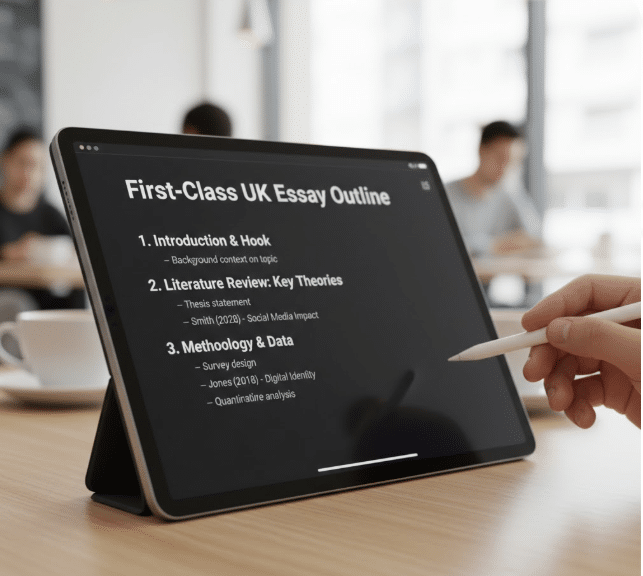
By using this method, you aren’t writing a 2,000-word essay. You are writing five 400-word sections. Mentally, this is much easier to handle and prevents you from feeling overwhelmed. It also ensures your essay has a logical flow, which is a major requirement for UK academic standards.
Step 4: Mastering the “PEEL” Paragraph
If you want to guarantee a first-class mark, every single paragraph in your essay should follow the PEEL structure. This is the secret weapon of high-achieving UK students.
- P – Point: Start with a clear sentence stating what the paragraph is about.
- E – Evidence: Provide a quote or data point from your research.
- E – Explanation: Explain how this evidence proves your point. (This is where the marks are!)
- L – Link: Connect this paragraph to your next point or back to the main essay question.
If you follow this, you can’t go wrong. It forces you to stay focused and prevents the “rambling” that often leads to lower grades.
Step 5: The “Baddie” Editing Shortcut
Never edit while you write. Writing uses the creative side of your brain; editing uses the logical side. If you try to do both, you will work at half speed. Write the whole draft—even if it’s messy—and then walk away.
Go get a coffee, go to the gym, or film a “Get Ready With Me” video. When you come back two hours later, your brain will be fresh. The best shortcut for editing? Use a text-to-speech tool to have your essay read aloud to you. If a sentence sounds awkward when you hear it, it will sound awkward to your professor. Fix it on the spot.
Step 6: Referencing Without the Headache
Referencing is the most boring part of any assignment, but in the UK, it can be the difference between a 65% and a 75%. Don’t do this manually. Use tools like Zotero or Mendeley, or better yet, use the built-in “References” tab in Microsoft Word.
Make sure you know whether your department requires Harvard, APA, or Oxford style. Using the wrong style is an easy way for a professor to dock marks, no matter how good your ideas are.
Balancing the “Aesthetic” and the “Academic”
We live in an era where appearance matters, but “Baddie” energy is about more than just looks—it’s about competence. There is nothing more confident than being the person who can go out on a Friday night knowing their essay is already finished, polished, and ready for a first-class mark.
The secret UK students use isn’t a magic wand; it’s just a refusal to waste time on things that don’t earn marks. They focus on the rubric, they use the PEEL method, and they aren’t afraid to use resources like myassignmenthelp when they need a boost in the right direction.
The “One-Night” Emergency Plan
If you’ve ignored all the advice above and you’re reading this with six hours to go until your deadline, don’t panic.
- Drop the Intro: Write the body paragraphs first. You can’t introduce an argument until you’ve actually made it.
- Focus on H2s: Make your headings clear and bold. It helps the marker see that you’ve covered the main topics.
- Simplicity over Complexity: Use clear, simple language. You don’t need a thesaurus to get a first-class mark; you need a clear argument.
Why Quality Over Quantity Wins Every Time
In 2026, Google (and your university professors) can tell the difference between “fluff” and “value.” A 1,500-word essay that is packed with deep analysis will always beat a 3,000-word essay that says nothing. This applies to your blog posts, your social media captions, and your university assignments.
If you want to be successful in the UK university system, you have to treat your education like a brand. You need a strategy, you need the right tools, and you need to know when to ask for an assist.
Final Thoughts for the UK Student
Getting a first-class degree doesn’t mean you have to be a hermit. By using the skeleton drafting method, the 80/20 research rule, and staying organized with the right academic support, you can have the lifestyle you want and the grades you deserve.
Frequently Asked Questions
How can I make my writing sound more professional?
Focus on using clear, direct language and avoiding slang. Transition words like “furthermore” or “consequently” help connect your ideas, while active verbs make your arguments feel more authoritative and convincing to the reader.
What is the best way to handle a tight deadline?
Break the task into smaller, manageable chunks. Instead of trying to finish everything at once, set a timer for focused intervals of work followed by short breaks. Prioritize the most important sections first to ensure the core requirements are met.
Why is an outline necessary before starting?
An outline acts as a roadmap, preventing you from getting lost or repeating yourself. It ensures your ideas flow logically and that you have a dedicated space for every piece of evidence required to support your main point.
How do I find high-quality sources quickly?
Start by looking at the reference lists of articles you already have. This “snowballing” technique leads you directly to the most influential papers in that field, saving you hours of manual searching through digital databases.
About The Author:
Lucy Wilson is a lifestyle strategist and lead contributor at MyAssignmentHelp. She is passionate about helping the modern generation balance their high ambitions with their personal well-being, ensuring they stay ahead of the game without losing their cool.
